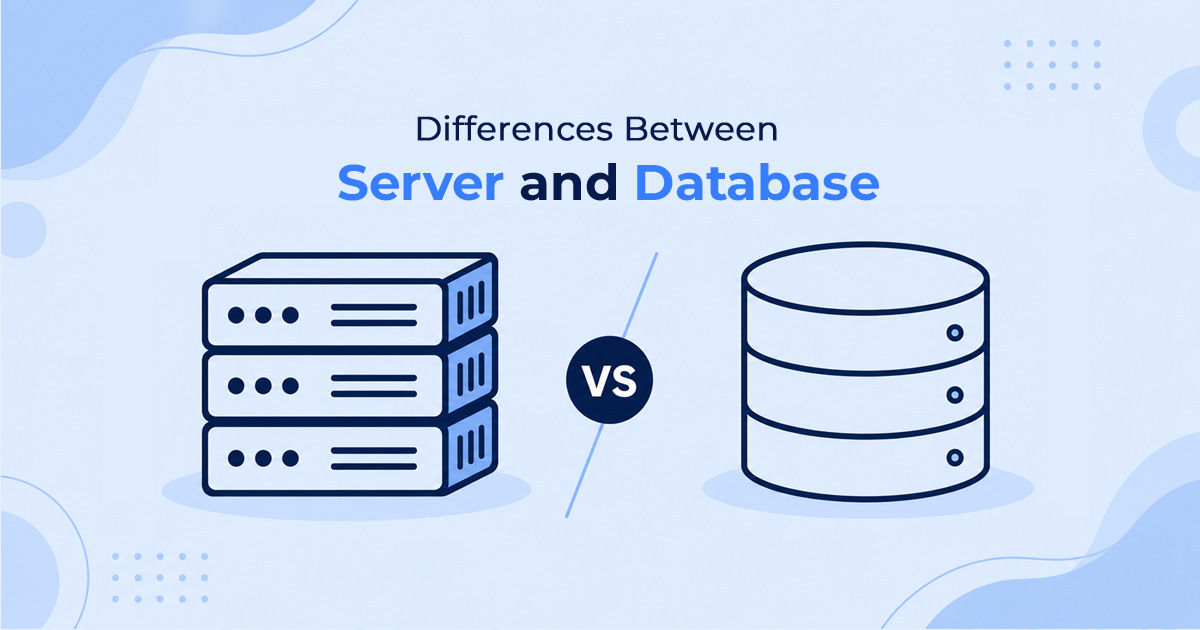
Differences between Server and Database 

The key difference between server and database is that a server is a computer program that runs to support services to other computer programs or devices, while the database is an application that stores information in an structured form and can be retrieved by the user with the help of a query. This article is a complete guide about differences between server and database

Differences between Server and Database

  • Server is a computer program that supports the requested services to other devices or computer programs, while a database is a collection of data that is conserved in an organized way, and can be accessed with the help of queries.
  • Server provides server related services. For instance a web server will only provide the web-based services. Database allows you to store the organised data in a structured manner.
  • Languages used in a server are PHP, Python, Ruby, Java, ASP etc, while a database uses languages like DDL, DML, DCL and TCL to define and manage itself.
  • Server’s function is to give services to many clients at the same time, whereas a database’s only function is to store and manage data.
  • There are different types of server like- web server, database server, proxy server, mail server etc. Databases are also of many kinds like- cloud database, relational database, distributed database, centralised database etc. There are lots of Differences between Server and Database. 

What is a Server in Networking? 

A server is a physical computer with a large disk drive that has a server program running on it. The server program provides services to other computer programs or devices (clients). The figure below illustrates the client-server model.The client-server model is more popularised and it creates the base of much used networks. differences between server and database

Server in Networking

What is Server Used for? 

Servers are used to provide various services to the clients like- 

  • Share (send and receive) data to/from multiple clients.
  • Share resources among multiple clients.
  • Storing data

How a Server Works? 

  • The main function of a server is to act according to the requested services put up by clients. The working of the server can be easily explained with the help of the client-server model.
  • The model includes two processes- a client process that runs on the client machine and a server process that runs on the server machine.
  • Now whenever the client requires any service it asks the server process, by sending a message. When the server process receives this message, it acts accordingly to the requested task. Or if the request is to seek some data its lookups for the requested data and sends a corresponding reply.

The more you will explore the more you will understand the working of a server through physical, virtual and software server. 

  • Physical Server:- It is a physical computer where the server software runs.
  • Virtual Server:- The virtual server is designed on the physical machine, and it has its own operating system and applications. To create a virtual server on a physical machine, one needs to install a software hypervisor on the physical machine. The hypervisor allows a physical machine to host several virtual servers by keeping the resources of one virtual server separate from the resources of another virtual server.
  • Server Software:- Like any software the server software also needs a minimum of one resource to run the operating system. The operating system supports the platform for server software to run. The operating system facilitates the server software to access the hardware resources.

Different Types of Servers 

Web server is the most common type of server that we come across that provides you web based services. But some other types of servers are- 

  • Web Server:- It is the one that provides all the web-based services requested by clients over the World Wide Web.
  • Email Server:- The email server manages the sending and receiving of emails between the business clients.
  • Database Server:- The database server is capable of hosting multiple databases. It manages the accessibility of clients to the data over the network.
  • Print Server:- The print server coordinates between the printers connected to the clients in the network.
  • Game Server:- It serves as a multiplayer gaming experience for the players present at different locations of the world.
  • Proxy Server:- It is a server that acts as an intermediate between clients and the server to which the client has requested the service.

Advantages of Servers 

  • The server functions centrally to control the clients connected to a network. ● There is a specialised server for every work.
  • The server is scalable.
  • The server helps in easy backup and recovery of your data.
  • Servers can be remotely accessed using various platforms.

Disadvantages of Server 

  • When there are too many client requests on the server at the same time it might lead to traffic congestion.
  • If there is a failure in the centralized server then it may cause a failure to the entire network.
  • Installing and maintaining its server is a cost-effective process.

What is Database? 

A database is an application that we use to store information in a structured way. It organizes the related data into a table under rows and columns. The user can retrieve data from the database with the help of queries. 

What is Database Used for? 

We use databases to store, maintain and retrieve the information. We even use it to aggregate or analyze the business information and make better decisions for the company’s benefit. 

Types of Database 

1. Centralized Database

It stores data in the centralized database system. The user can remotely access the centralized database system with the help of some application.

2. Distributed Database

Distributed database as the name suggests, here we store data on the different database systems of the company. However, these distributed systems are connected to each other with the help of a communication link. The distributed database is further classified into two types: NoSQL is a ‘not only SQL’ database.

It has a non-tabular structure and it stores data differently from the relational database. NoSQL databases store data in various ways, it totally depends on the data model used. The NoSQL database can store data in the form of documents, graphs, key-value and wide-column. 

3. Relational Database

The relational database stores information in one or more tables of rows and columns. Each row in a table represents an entity and the columns represent the attribute of these entities. 

4. Network Database

The network database is structured on the network data model. Here each record can have multiple parent records and multiple child records. Thus, the network database provides multiple access paths to the data. 

5. Object-Oriented Database

It is a collaboration of object-oriented programming and a relational database. It stores in the form of objects that are nothing but the instances of the classes.

 6. Hierarchical Database 

A hierarchical database organizes data in a tree-like structure. Here each record has a single parent and multiple child records connected to parent records through links. This is one of the major differences between server and database. 

So, we can conclude that differences between server and database give us clarity to Choose wisely. We create a server to offer services to the clients connected to it. We create a database for storing data in an organized way. We hope you will find this article helpful for your project purposes, and the difference is clear to you.


Meenakshi Thakur

Meenakshi Thakur, having 6 Years of Experience in Digital Marketing and Content Writing. I am free to write all types of niche content for websites and blogs. I am passionate about all of the work! I really like to explore the latest tricks in technical areas and develop case studies.

Recent Blog

Why Multimedia Contents Websites Still is Relay-Upon FFmpeg Hosting?

Nowadays, the trend of multimedia content-based websites is tremendously popular. However, these types of websites can’t host on common or…

Differences between Server and Database 

The key difference between server and database is that a server is a computer program that runs to support services…

Intel vs AMD Processor: Which One is the Best ?

Whenever there is a debate of choosing the best computer processor Intel vs AMD processor has been dominating the tech…

Copyright © 2019 Max Cloud Host. All Rights Reserved.