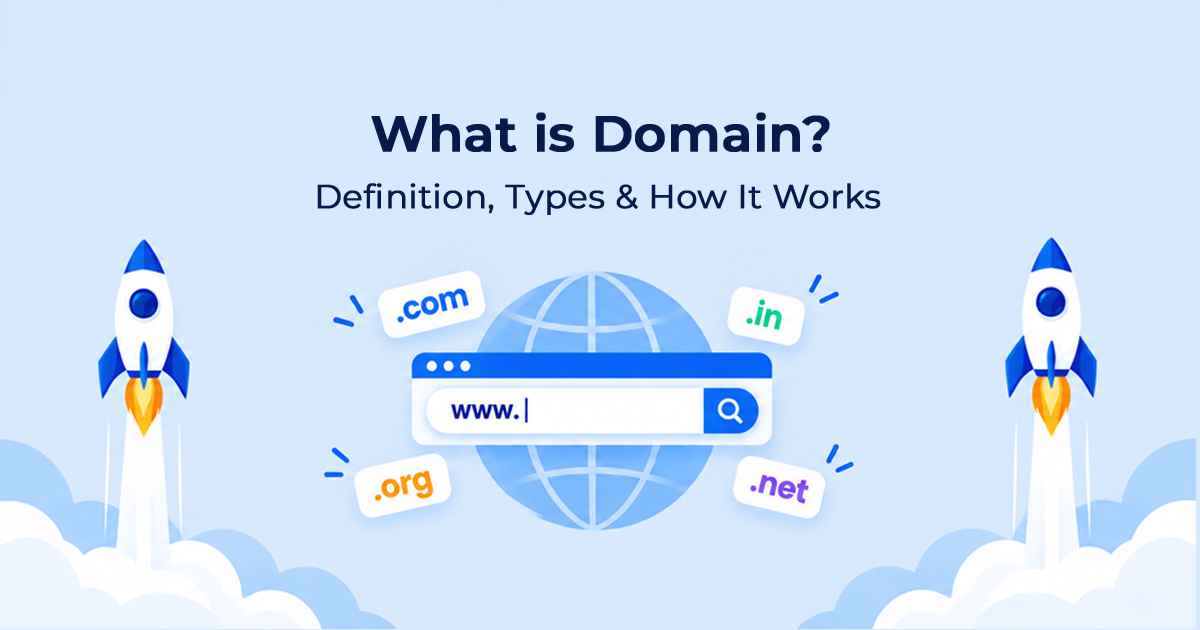
Do you know What is a Domain Name?. A domain name is an address that is used to find a website. It is a helpful tool for raising brand awareness, increasing sales or marketing any product. In this article we will talk about domain names, its different types and how it works.
A domain name is an address to identify and access a website on the internet. Every domain name has a particular identifier for a particular web location that allows users to find the web page easily by typing or clicking on familiar names, instead of remembering hard numerical IP addresses. Domain names are important for online branding, marketing, and navigation that makes the internet user-friendly and easily accessible.
Domain names are generally registered through domain registrars and need an annual renewal to hold the ownership. Let’s discuss about deeply What is a Domain Name and where we can use a domain etc.

In a URL, a domain name is usually found just after the protocol and double slashes, which is “http://”. The domain name always comes before any extra resource identifiers. For example, in the URL, “http://google.com/page”, www.google.com is the domain name.
Domain names have unique identifiers that allow the browser to create a request to the location of the particular website on the internet. Domain names are significant to access websites, as they support a user-friendly approach to navigate through the vast choices of online landscape.
To make your domain work efficiently one must need to follow few basic methods and they are:
Registration: To buy domain names, you have to do it through domain registrars. Domain registrars are intermediaries that work between domain users and the domain governing bodies, like ICANN (Internet Corporation for Assigned Names and Numbers). Users can select domain names with a top-level domain (TLD) option like .com, or .org, or with country-code TLDs.
While completing the registration process the user must need to provide contact details, and has to agree with the terms and conditions. Terms and conditions also include periodic renewal fees that will protect the ownership of any particular domain.
DNS (Domain Name System): The DNS is a widespread network of servers that work as the internet’s address book. When you first enter a domain name through a web browser, the browser sends a query to a DNS server to translate the specific domain name like- www.googole.com into an IP address, like “8.8.8.8” which is important for computers to locate the web server connected with the domain.
IP Address Resolution: After the query is sent DNS server searches its database to find the requested domain name. Once it is matched it retrieves the true IP address linked with that domain. If the DNS fails to find the match, it may send a query to other reliable servers until it can find the correct IP address. Once the IP address is detected it will return to your device.
Website Retrieval: Once the IP address has been retrieved, your web browser gets linked to the web server connected with the domain. It sends a request for the particular web page or resource that you are looking for. After receiving the request the web server will process the request and transmit the request web page or website, which your browser provides for you to see on your screen.
Domain names make internet navigation easy, as users can remember the names instead of the complex IP addresses, which will make it easier for the users to access any website without any hassle.
A domain name has many parts with specific functions that gives a structured and inbuilt way to find and access websites on the internet.
Subdomain: A subdomain is an optional prefix that can be added before the original domain. For example, in “shop.example.com”, the term “shop” is a subdomain. Most of the time subdomains are used to differentiate content within a website.
Second-Level Domain (SLD): This is the main part of the domain name that gives the initial identity for a website. For example, in the web address “www.google.com”, the term “google” is the second-level domain.
Top-Level Domain (TLD): TLD always comes after the second-level domain and is the rightmost part of the domain. This part of the domain represents the category or purpose of the website. There are common TLDs like .com, .org, .net. Country-code TLDs (ccTLDs) include .uk or .ca that are linked with particular countries.
These different parts of a domain are combined together to create a complete domain name that gives a structured way to find and access a website on the internet.

There are different types of domain names and each of them serves a specific purpose. Choosing the right domain name and extension depends on the type of your website, your audience and what are your goals behind the website. Each type of domain comes along with their own benefits and can cause a big difference in how the audience will locate and acknowledge your website.
Generic Top-Level Domains (gTLDs): These are the most basic types of domain and consist of easy extensions like .com, .org or .net. They are adaptable and suitable for a wide range of websites.
Country Code Top-Level Domains (ccTLDs): These types of domain extensions are connected with particular countries or regions. For example, .uk for the United Kingdom, .in for India or .ca for Canada. They often used to symbolise a local or territorial presence.
Sponsored Top-Level Domains (sTLDs): These are specific domain extensions used by particular organisations or industries. For example, .gov stands for government bodies or .edu indicates educational organisations.
New gTLDs: These types of domains have been introduced recently and have various options than regular gTLDs, like .app, .blog, .guru etc. These types of domain can be more vivid and applicable to particular website content.
Brand TLDs: These are for particular companies like .apple or .google that strengthen their brand identity.
Website Identification: Domains not Only provide an add let’s ress it also acts as an important element when it comes to website accessibility and navigation. Domains are user-friendly and easy to remember which helps the audience to get connected with the website and they can easily share it too. Without domains users have to remember the IP addresses which is a bit challenging.
Branding and Identity: Domains are the first thing to create a connection between a business and their online audiences. Choosing a right domain name can create an opportunity to convey a brand’s identity, significance and goals. Catchy domain names are most likely to be shared or revisited by audiences.
E-commerce: Domain name is the key feature for any online business. A suitable domain name can easily attract customers for your business. User experience is a basic part of e-commerce, and it is often linked with the protection and the reputation of the business. So the more customers the better the growth for your business.
Content Publishing: Nowadays, domains are the pillar of any digital publishing platform. Bloggers or content creators are truly dependent on domains to reach their audiences. Domain names can help to access information. It can also promote the spread of knowledge, news and entertainment on the web.
Read More :- Differences between Server and Database
Read More :- Difference Between .com and .in Domain
We hope that this complete guide about domain names, its types and its functions will give you a clear idea about everything you need to know about domains.

Meenakshi Thakur, having 6 Years of Experience in Digital Marketing and Content Writing. I am free to write all types of niche content for websites and blogs. I am passionate about all of the work! I really like to explore the latest tricks in technical areas and develop case studies.
Email remains the most essential communication medium in business today. Businesses use email to communicate with suppliers, customers,…
Read more →
Today, email remains the primary communication channel for businesses. Even with the availability of Instant messaging, virtual meetings,…
Read more →
Let's discuss about Top 10 Payment Gateways in India. A payment gateway is a technology that provides protected…
Read more →